 The description of a homonym covers that of both a homograph and a homophone. For example, ‘bear’, ‘tear’ and ‘lead’ are all homographs, but they also satisfy the criteria of a homonym.
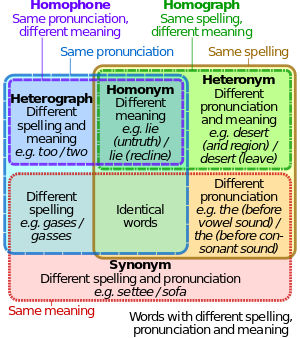 The word homonym comes from the Greek ὁμώνυμος (homonymos), meaning "having the same name," [6] compounded from ὁμός (homos) "common, same, similar" [7] and ὄνομα (onoma) "name."